Jungian Model of Psyche
What is the Jungian Model of the Psyche? There are hundreds of psychological methodologies in how to approach the psyche, but one stands apart from the rest and that is Carl Jung’s model. The Swiss Psychologist, Carl Jung’s unique insight into the unconscious makes his model more expansive than any other depth coaching model. He said that there are two layers to the unconscious – the personal and the collective.
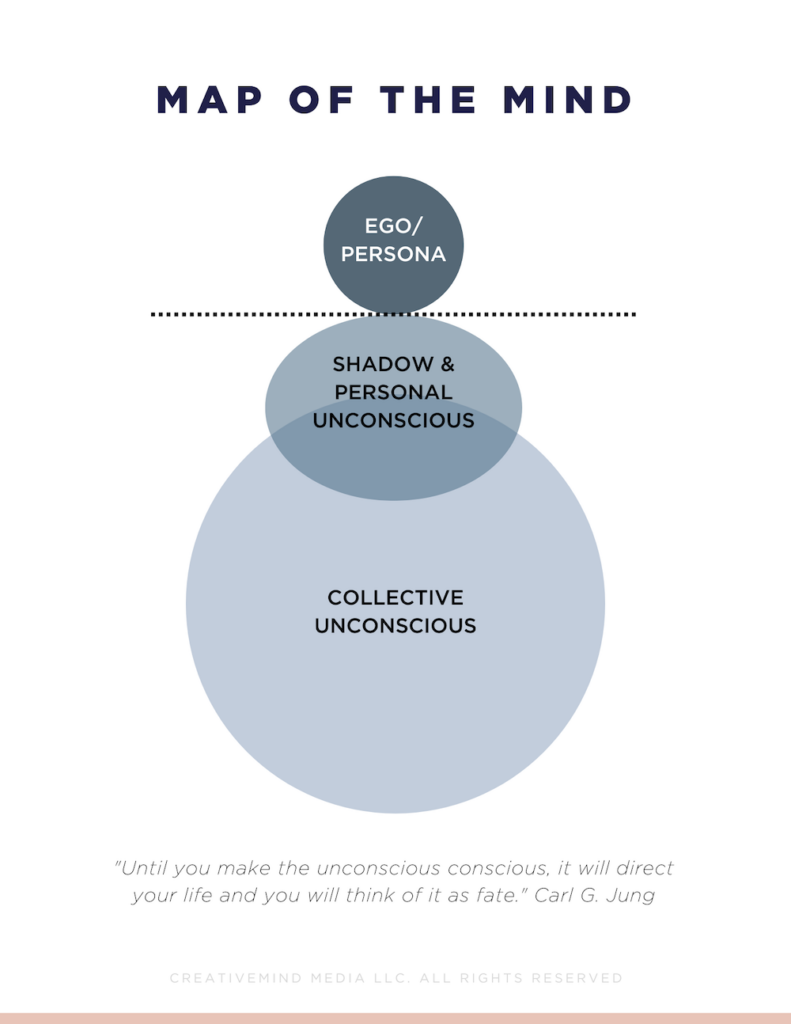
Here is an outline of Jungian Model of the Psyche to follow below:
Personal Unconscious
According to Jung, the personal unconscious contains all of the rejected personality traits (the shadow) as well as repressed memories and emotions that are influencing your life without your awareness. Most psychological models stop here.
Our early life before 9 creates a template that we create our life from and operate automatically. Some call this our “programming” or “conditioning.”
Collective Unconscious
Here lies the brilliance of the Jungian model of the psyche. He said that deeper than our personal unconscious we also have what he called a “collective unconscious” – a shared consciousness that contains wisdom from all of humanity. Think of it as a universal intelligence within us beyond our personal experience.
The Collective Unconscious contains Archetypes, they are like a matrix of organizing patterns that we see in humanity and nature. Think of the concept of Mother. We all have a mother or idea of what mother is, even before we are able to understand the label. We sense that this woman is going to take care of us.
The Ego – Persona
In the first part of life, we develop what Jung called an ego or sense of “I” – a conscious self-concept that is a natural effect of having a body and feeling the separation from others. You and I are different. The ego’s job is to help you survive both physically and socially. We create a “mask” or persona that we wear in front of others to create a personality that is accepted or admired by others. We do this to fit in and build a social character.
What we reject gets suppressed into our Shadow (personal unconscious). The important point here is that these qualities do not go away, they end up being projected onto others. For example, if you repress being assertive because you were shaped to believe that was “not nice or pleasing” because of possibly an early rejection of that trait from a parent or other adult, it goes into your shadow. You create a mask that is pleasing and passive but end up feeling like a victim. You see the assertive qualities in others and they annoy you.
Whatever we judge in others, we judge in ourselves. The way to face the shadow is to make it conscious through recognizing our projections, triggers, seeing them show up in our dreams and through active imagination.
Make it Conscious – Individuation
The goal of Jung’s work is not to heal the past, but to make the unconscious conscious. By making it conscious, we are able to choose our fate. This methodology is very empowering and actually really aligned to work within a coaching model. He called the process of making it conscious, Individuation.
Individuation is the journey from ego-centered consciousness to becoming your true self. If you look at the Jungian Map of the Psyche, you will see how much depth and wisdom is in this model.
Jungian Coaching
CreativeMind, founded by Robert Maldonado, PhD and Debra Maldonado, offers an alternative to Jungian therapy through Jungian Coaching. True to the Jungian Model of the Psyche, a Jungian coach sees the person they are working with as not broken. Understanding that a person creates an ego and that it is a universal pattern of human development, not a pathology to be fixed.
Jungian Coaches approach the unconscious mind through Shadow Work, Active Imagination, Coaching with Self-Inquiry, Dream Interpretation, Emotional Power Integration (EPI) and more. No matter what a person’s personality is like such as creative or logical, the method can be used by anyone who wishes to undergo the Individuation process.
What is the potential for Jungian Coaching?
A person realizes how much of their life was driven unconsciously. They get to redefine who they are on their terms and change life-long patterns in an accelerated way. The biggest benefit is entering the life of meaning and purpose. They discover a spiritual aspect of themselves that is creative, mythic and imaginative.
This model is inspired by Carl Jung’s original writings on the psyche and individuation, interpreted through a modern Jungian coaching lens.
It is the journey you were meant to be on.
FAQs About Jungian Model of the Psyche
What is the Jungian Model of the Psyche?
It contains ego, persona on a conscious level. The unconscious is split into two parts – personal and collective. The personal contains the “shadow” and the collective unconscious contains “archetypes.”
Why is Carl Jung’s Model different than other psychological models?
Most models are foundations of Freudian psychology which only addresses the personal unconscious. Jung also included the concept of the collective unconscious. Jung also believes the unconscious wasn’t a dormant storehouse but an active living source that is actively creating with us.
Is Jungian Psychology spiritual?
It depends on who you ask. Some in the therapy models avoid spiritual language but Jungian Coaches include spirituality as a part of the coaching experience.